
First-Year Vegetable Garden Checklist: From Site to First Seedlings
Updated
Figures checked against their sources on ; next check .
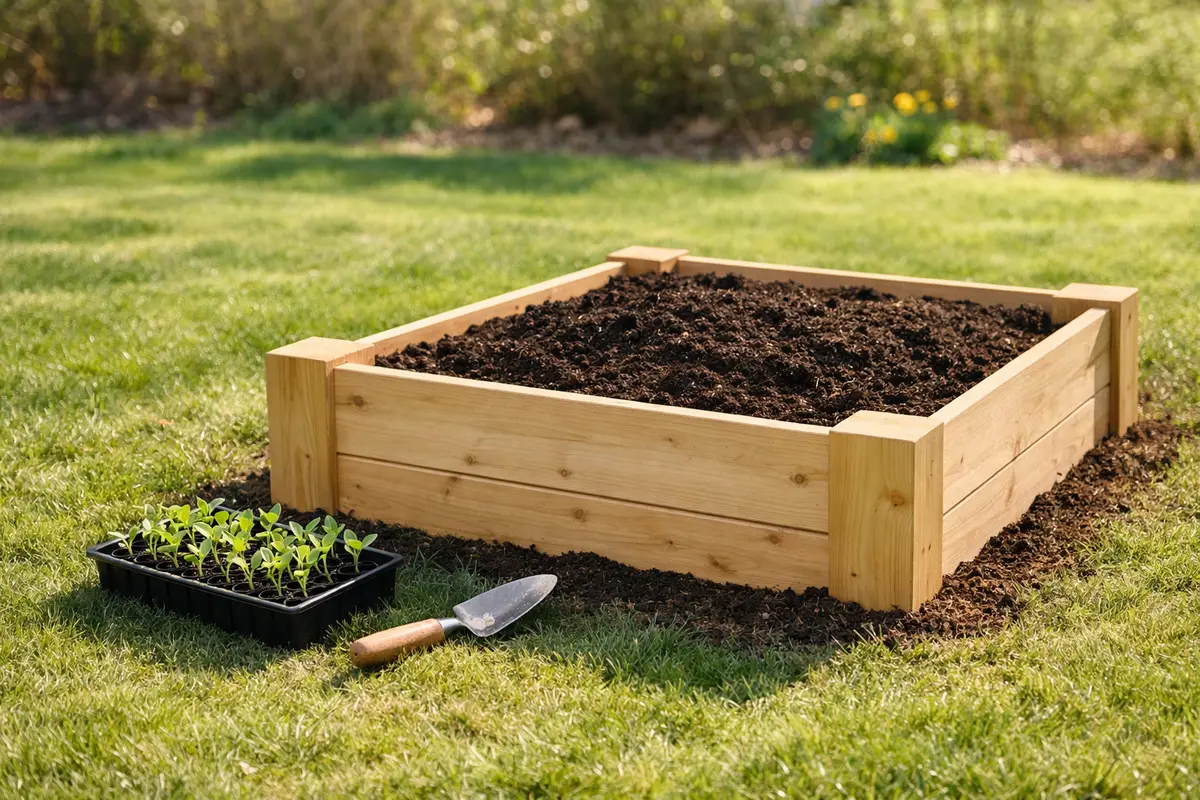
First-year vegetable garden checklist
Check these off from site choice to the first harvest. Your checkmarks stay in this browser; nothing is sent anywhere.
0 of 14 done
Pick the spot
Penn State Extension calls picking the right spot crucial.
Source: Penn State Extension, Home Gardening: Planting and Growing
Penn State Extension says most vegetables need plenty of moisture.
Source: Penn State Extension, Home Gardening: Planting and Growing
Penn State Extension suggests raised beds for poor soil. For the amount of soil a bed needs, use a calculator: Calcimator's garden calculators are at https://calcimator.com/calculators/home-garden.
Source: Penn State Extension, Home Gardening: Planting and Growing
Know your soil
Penn State Extension says soil quality is essential when you begin; a test tells you where yours stands.
Source: Penn State Extension, Home Gardening: Planting and Growing
UW-Madison Extension says a pH of about 6.5 is ideal for growing most vegetables. Add lime only on a soil test's advice, because lime raises pH.
Know your frost date
NOAA's climate normals give the typical date and a later one that only one year in ten beats. Frost dates on this site come from that record.
University of New Hampshire Extension: do not seed or transplant frost-sensitive plants before your last frost date.
Lay it out
That is NC State Extension's distance between plants. Its table gives plant spacing only, not row spacing, so take row width from the seed packet.
Iowa State Extension says to keep a family out of one spot for 3 to 4 years. Penn State Extension also recommends rotating by family for pest management.
Source: Iowa State University Extension and Outreach (Aaron Steil), Crop Rotation in the Vegetable Garden
Start seeds
Illinois Extension says this guards against damping off, which cannot be cured once it starts.
Illinois Extension recommends this range. Cold holds seeds back: tomato's lowest germination temperature is 50 degrees F in Auburn's chart.
Illinois Extension says insufficient light is the most common cause of leggy seedlings.
University of Minnesota Extension moves seedlings outside for short spells, then longer ones, before they go in the ground.
Source: University of Minnesota Extension, Starting seeds indoors (page reviewed 2026)
Through the season
UW-Madison Extension ties blossom end rot in tomatoes to alternating soil moisture extremes, and advises watering evenly and mulching.
Sources (9)
- Penn State Extension, Home Gardening: Planting and Growing extension.psu.edu
- University of Wisconsin-Madison Division of Extension (Joy and Hudelson), Blossom End Rot, revised November 19, 2024 pddc.wisc.edu
- University of New Hampshire Cooperative Extension, Growing Vegetables: When to Plant Your Vegetable Garden (fact sheet) extension.unh.edu
- NOAA National Centers for Environmental Information, U.S. Climate Normals 1991-2020, annual and seasonal normals (frost/freeze probabilities by station) ncei.noaa.gov
- NC State Extension (Bradley, Gunter, Sherk and Driscoll), Central North Carolina Planting Calendar for Annual Vegetables, Fruits, and Herbs, AG-756-01, published July 8, 2016 content.ces.ncsu.edu
- Iowa State University Extension and Outreach (Aaron Steil), Crop Rotation in the Vegetable Garden yardandgarden.extension.iastate.edu
- University of Illinois Extension (Ken Johnson), What's wrong with my seedlings? Troubleshooting seed starting problems, February 25, 2022 extension.illinois.edu
- Alabama Cooperative Extension System (Auburn University; Oliveira, da Silva, Smith and Kemble), Soil Temperature Conditions for Vegetable Seed Germination, ANR-1061, revised January 2023 aces.edu
- University of Minnesota Extension, Starting seeds indoors (page reviewed 2026) extension.umn.edu
In short: Pick a spot with enough sun and water, test the soil, check pH against what you plan to grow, space and rotate by the charts, and start seed in clean mix with warmth and light.
How this list is built
A first garden fails less from one big mistake than from a few skipped steps. This checklist walks through them in the order a new gardener meets them: where to put the garden, what is in the soil, when frost lets you plant, how to lay out the beds, how to start seed, and one habit for the growing season. Every item names the Extension or NOAA source behind it, and every figure is read from the same typed data as the charts elsewhere on this site, so the numbers cannot drift from them.
Ticks are saved in your browser. The print button gives a clean copy for the garden shed, and the copy button turns it into plain text for a note on your phone.
Site and soil
Penn State Extension calls the choice of spot crucial and says most vegetables need at least 6 to 8 hours of full sun every day, along with plenty of moisture. It also says the quality of the soil is essential when you begin, and suggests raised beds if you are worried about yours. A soil test through your state Extension office is the way to learn what you have. When the result comes back, University of Wisconsin-Madison Extension gives about 6.5 as ideal for most vegetables, and warns that lime raises pH, so add it only when a test says to.
Frost and timing
Your last spring frost decides when tender crops can go out. University of New Hampshire Extension puts it bluntly: find the date for your area first, and do not seed or transplant frost-sensitive plants before it. The frost dates lookup gives that date for the NOAA weather station nearest you, along with the later, safer date that holds in nine years out of ten, which is the one to use for plants you cannot cover.
Layout and rotation
NC State Extension puts tomato plants 18 inches apart; its table gives the distance between plants and no row width, so take row width from the seed packet. Iowa State advises keeping a plant family out of one location for 3 to 4 years, which only works if you write down what you planted, so the checklist asks you to record each crop's family. The rotation page lists the families.
Starting seed
Illinois Extension is the source for most of the seed-starting items: new, well-draining, sterile mix rather than garden soil or compost, warmth around 70 to 75°F, and strong light once seedlings emerge. Alabama Extension's germination chart shows why warmth matters; tomato's floor is 50°F. Before the seedlings go in the ground, the University of Minnesota hardens them off over 2 weeks, starting with a few hours of afternoon shade and building up to full sun.
Worked example: planning a tomato bed
Say your sunniest spot gets the hours above, and the soil test comes back close to the pH target. You tick the site and soil items. You look up your station's frost dates and mark the later one, because tomatoes are frost-sensitive. For layout you set the plants at the gap in the spacing item and write nightshade beside the bed in your notes, which tells next year's you to put a different family there. Count back from the frost date to start the tray in clean mix at the tray temperature, give the seedlings strong light, and begin hardening them off 2 weeks before planting day. Each of those is a tick on the list, and none needs a purchase beyond a soil test and some seed-starting mix.
What this list leaves out
It does not size a bed or work out how much soil to buy: that is a calculation, and the garden calculators on Calcimator are the place for it. It does not recommend a fertilizer or pesticide, and where a product is involved, its label is the guide. For problems along the way, the seeds not germinating troubleshooter covers the common seed-tray failures.
Sources (9)
- Penn State Extension, Home Gardening: Planting and Growing extension.psu.edu
- University of Wisconsin-Madison Division of Extension (Joy and Hudelson), Blossom End Rot, revised November 19, 2024 pddc.wisc.edu
- University of New Hampshire Cooperative Extension, Growing Vegetables: When to Plant Your Vegetable Garden (fact sheet) extension.unh.edu
- NOAA National Centers for Environmental Information, U.S. Climate Normals 1991-2020, annual and seasonal normals (frost/freeze probabilities by station) ncei.noaa.gov
- NC State Extension (Bradley, Gunter, Sherk and Driscoll), Central North Carolina Planting Calendar for Annual Vegetables, Fruits, and Herbs, AG-756-01, published July 8, 2016 content.ces.ncsu.edu
- Iowa State University Extension and Outreach (Aaron Steil), Crop Rotation in the Vegetable Garden yardandgarden.extension.iastate.edu
- University of Illinois Extension (Ken Johnson), What's wrong with my seedlings? Troubleshooting seed starting problems, February 25, 2022 extension.illinois.edu
- Alabama Cooperative Extension System (Auburn University; Oliveira, da Silva, Smith and Kemble), Soil Temperature Conditions for Vegetable Seed Germination, ANR-1061, revised January 2023 aces.edu
- University of Minnesota Extension, Starting seeds indoors (page reviewed 2026) extension.umn.edu