
Powdery Mildew on Squash, Tomatoes and Fruit: What to Do
Updated
Figures checked against their sources on ; next check .
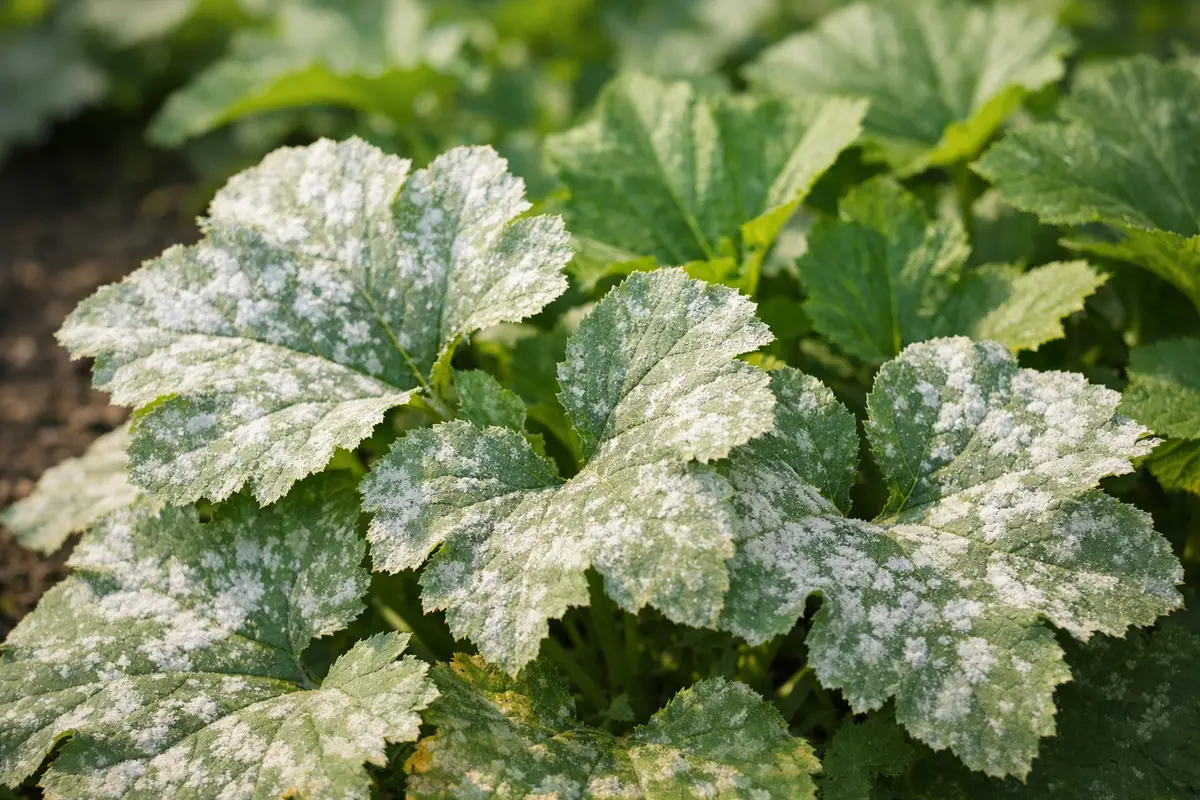
White powder on the leaves: is it powdery mildew, and what now?
Start with what the growth looks like, then how far it has spread. Every answer follows the University of California's Pest Notes on powdery mildew.
What does the growth look like?
Turn a leaf over and look at both sides in good light.
White to gray powder on both sides of the leaves, sometimes on shoots, flowers or fruit
How far has it spread?
A few spots, or a shoot or two
Deal with it soon
A small outbreak: cut it out and wash it off
UC IPM says that where infection is limited, you can prune out and bury or discard diseased tissue as soon as it appears. Infected tissue shows as young emerging leaves that are deformed or puckered.
What to do
- Prune out the infected leaves and shoots, and put them in the compost, green waste or trash. UC IPM says properly maintained compost piles should kill the spores.
- Wash spores off with overhead sprinkling, done midmorning so the leaves dry quickly. UC IPM warns that a brief watering can spread spores to clean leaves, while long overhead sprinkling washes them off.
- Improve the conditions: more sun, better air circulation from pruning and spacing, and no excess nitrogen.
Mild to moderate: spreading across several leaves
Deal with it soon
A mild to moderate infection: an oil spray can stop it
UC IPM says mild to moderate infections can be controlled with horticultural oil or plant-based oils such as neem oil, and that oils work best as eradicants, killing an existing infection, though they also protect. Most other fungicides, sulfur among them, only prevent new infections. Oils carry two limits: never within 2 weeks of a sulfur spray, and never when temperatures are above 90°F or on drought-stressed plants.
What to do
- Check when sulfur was last used on the plant. If it was within 2 weeks, do not use an oil yet.
- Check the forecast: no oil spray when it will be above 90°F, and water drought-stressed plants before treating them.
- Read and follow the product label; UC IPM says to consult it for any special precautions.
- Prune out the worst leaves and improve sun and air circulation as well.
Most of the leaves are covered, and some are yellowing or falling
Deal with it soon
A heavy infection: harder to control now, so plan ahead
UC IPM says that once mildew growth is extensive, control with fungicides becomes more difficult. Infected leaves turn yellow or brown and fall off, which can expose the plant or its fruit to sunburn. On vegetables the fruiting parts are usually not affected.
What to do
- Remove the worst leaves and dispose of them in the compost, green waste or trash.
- If you treat, an oil is the one option UC IPM names for an existing infection, with its limits: not within 2 weeks of sulfur, not above 90°F, not on drought-stressed plants. Read and follow the product label; UC IPM says to consult it for any special precautions.
- Next season, start with resistant varieties and a sunny, airy spot.
Gray patches, mostly on the underside of the leaves
Deal with it soon
This may be downy mildew instead
UC IPM tells the two apart this way: powdery mildew forms a white to gray powdery growth on both sides of the leaves, while downy mildew colonies are gray instead of white and occur mostly on the lower leaf surface. Downy mildew's spores also grow on branched stalks that look like tiny trees.
What to do
- Compare the two sides of a few affected leaves: white growth on both sides points to powdery mildew, gray growth mostly underneath to downy.
- This page covers powdery mildew only. For downy mildew, ask your county Extension office.
Nothing now, but it covered the plants last season
Keep an eye on it
It came back last year: prevention is the best control
UC IPM calls prevention the best method of control. The disease favors moderate temperatures, 60 to 80°F, and shade, and unlike many diseases it does not need moist conditions: it is common in warm, dry weather. Where it has been a problem before, fungicides may be needed, but most of them, sulfur included, work only if applied before the first sign of disease.
What to do
- Plant resistant varieties. UC IPM lists them for melon, pumpkin, squash, cucumber, bean and pea, and for apple, raspberry and peach.
- Grow in full sun, space and prune for air circulation, and avoid excess nitrogen, which makes lush, shading growth.
- If you plan to use sulfur, it must go on before symptoms appear. UC IPM says not to use it when it is near or over 90°F (80°F for caneberries and strawberry), within 2 weeks of an oil spray, or on apricot trees at any temperature. Read and follow the product label; UC IPM says to consult it for any special precautions.
Yellow, irregular blotches on tomato leaves, often with little or no white powder
Keep an eye on it
Tomato powdery mildew: yellow blotches, usually no heavy white coat
UC IPM describes powdery mildew on tomato as irregular yellow blotches on the leaves, the centre of each dying as it widens, with spots of dead tissue that sometimes have rings like early blight; a gray growth on the leaf surface is rare. It says there are no lesions on stems or fruit and no discoloration inside the stem as with Verticillium or Fusarium wilt. Utah State lists the tomato fungus, Leveillula taurica, among the powdery mildews and notes that in that group the threads grow within the host's tissue, which fits the lack of a heavy white coat. UC IPM says the disease turns up late in summer or fall and does not cause significant losses unless very severe, so no control is normally needed.
What to do
- Check the stems and fruit. If they are marked, or the stem is discolored inside, this is not tomato powdery mildew: send a photo or sample to your state Extension plant diagnostic lab.
- Late in the season, do nothing more than water evenly: UC IPM says to avoid water stress, and that no control is normally needed.
- On a young plant, UC IPM says sulfur will control the disease. Utah State warns that sulfur applied above 80°F can injure plants. Read and follow the product label; UC IPM says to consult it for any special precautions.
- Remove and destroy badly affected leaves, and at the end of the season clear the infected plants. Utah State says not to compost them, because compost piles do not get hot enough to kill the fungus.
- Space plants for air movement and water in the morning so leaves dry before evening, as Utah State advises.
In short: Powdery mildew is the white to gray dust that spreads over both sides of a leaf in warm, dry weather. Answer two questions to confirm it and see what fits how far it has spread: prune and wash a small outbreak, use an oil on a moderate one within its temperature limits, or plan prevention for next season.
How to recognize it
Powdery mildew is one of the easier plant diseases to name. The University of California's Integrated Pest Management program, in its Pest Notes for home gardeners (publication 7494), describes a white to gray powdery growth on both sides of the leaves, sometimes on flowers, fruit and shoots. The spots start small and spread as the infection grows. Leaves can twist or distort, then yellow, brown and drop.
Its usual lookalike is downy mildew, and the leaf tells them apart. Downy mildew colonies are gray rather than white, and they sit mostly on the underside of the leaf. If that is what you see, the tree above says so and sends you to your county Extension office, because this page covers powdery mildew only.
Why it shows up in dry weather
Many plant diseases need moisture. Powdery mildew does not: UC IPM says many species can germinate and infect without water, and that water on the leaf can kill some spores. The disease is common in warm, dry spells, favors moderate temperatures of 60 to 80 °F and shade, and is held back by direct sun and extreme heat. Spores travel on the wind, and UC IPM adds that moisture in spring holds the disease back, so it tends to build once the weather dries out.
It also explains the prevention advice. Sun, air moving through the plants, and no excess nitrogen, which UC IPM says makes lush foliage and shade, all work against the fungus. So do resistant varieties: UC IPM lists them for melon, pumpkin, squash, cucumber, bean and pea among vegetables, and for apple, raspberry and peach among fruit.
Worked example: neem oil a week after sulfur
A gardener sees white spots spreading across several zucchini leaves in a dry August. Last weekend she dusted the plants with sulfur, and now she wants to try neem oil. The tree sends her to the mild to moderate outcome, where an oil is the right tool, because UC IPM says oils work best at killing an existing infection, while sulfur only protects leaves that are not yet infected.
The timing stops her. UC IPM warns never to apply an oil within 2 weeks of a sulfur spray, either way round, or the plants may be injured. She waits, prunes out the worst leaves in the meantime, and checks the forecast before she sprays: no oil above 90 °F, and not on plants that are short of water. When she does spray, she follows the product label. Sulfur has a heat limit too, near or over 90 °F, and a lower one of 80 °F for caneberries and strawberry.
Tomato powdery mildew: yellow blotches, not always white powder
Tomato gets its own powdery mildew, and it does not look like the white dust on squash. University of California IPM describes irregular yellow blotches on the leaves. As each blotch widens, the leaf tissue at its centre dies, and the dead spots can show rings like those of early blight. Severely affected leaves die but seldom drop, and a gray growth on the leaf surface is rare. UC IPM adds that there are no lesions on the stems or the fruit, and no discoloration inside the stem as there is with Verticillium or Fusarium wilt, which is a useful way to rule those out.
The fungus is Leveillula taurica. Utah State Extension's vegetable sheet lists it for onion, pepper and tomato, and lists different species for squash, cucumber and melon. Those fungi are host-specific, Utah State says, meaning each survives only on its own kind of host, so the mildew on your squash is not the one on your tomatoes. The sheet also notes that in the Leveillula group the threads grow within the plant's tissue, which fits the blotchy look with little powder. It says the white growth shows 7 to 10 days after the first infection, that warm, dry weather of 75 to 85 °F with high evening humidity drives epidemics, especially in crowded plantings, and that older leaves go first.
Tomato powdery mildew: what to do about it
UC IPM's advice is calm. The disease occurs late in summer or fall and does not cause significant losses unless it is very severe, so no control is normally needed; if young plants are attacked, sulfur will control it, and water stress should be avoided. Utah State's cultural advice is to space plants for air movement, water in the morning so leaves dry before evening, use drip where possible, and remove infected material after harvest. It lists 5 tomato varieties among its examples of resistant vegetables.
The two sources disagree on two small points, and we do not average them. Utah State says not to put infected plants in the compost because the pile does not get hot enough to kill the fungus, while the UC IPM fruit-and-berry Pest Notes behind the rest of this page say a properly kept compost pile should kill the spores. For tomato, follow the cautious one and bag the debris. On sulfur, Utah State warns of plant injury when it is applied above 80 °F, a lower limit than the general one in the fruit notes. The product label is the rule for either.
Example: yellow blotches in September
A gardener sees yellow, blotchy lower leaves on her tomatoes in September, with little white powder and clean stems and fruit. She picks the tomato option in the tree. It ends at tomato powdery mildew, which at that point in the season needs no spray: she waters evenly, removes the worst leaves, and bags the plants at the end of the year.
What this page does not do
It names no products and gives no rates. UC IPM notes that its pesticide information can go out of date as products change, and that some products are only for licensed applicators, so every spray step here sends you to the label. The Pest Notes were written for fruit and berries and last updated in January 2011; we use them for vegetables only where they name vegetables.
Related pages
Give plants room for air to move with the plant spacing chart. If your squash is flowering but setting nothing, that is a separate problem: see squash flowers but no fruit. The first-year garden checklist covers choosing a sunny site.
Sources (3)
- University of California IPM (Gubler and Koike), Pest Notes: Powdery Mildew on Fruits and Berries, UC ANR Publication 7494 ipm.ucanr.edu
- University of California IPM, Home and Landscape, Powdery Mildew on Tomato (Leveillula taurica) (undated page) ipm.ucanr.edu
- Utah State University Extension (Volesky, Murray and Nischwitz), Powdery Mildew on Vegetables, April 2021 extension.usu.edu