
Leggy Seedlings Fix: Why Seedlings Stretch and How to Stop It
Updated
Figures checked against their sources on ; next check .
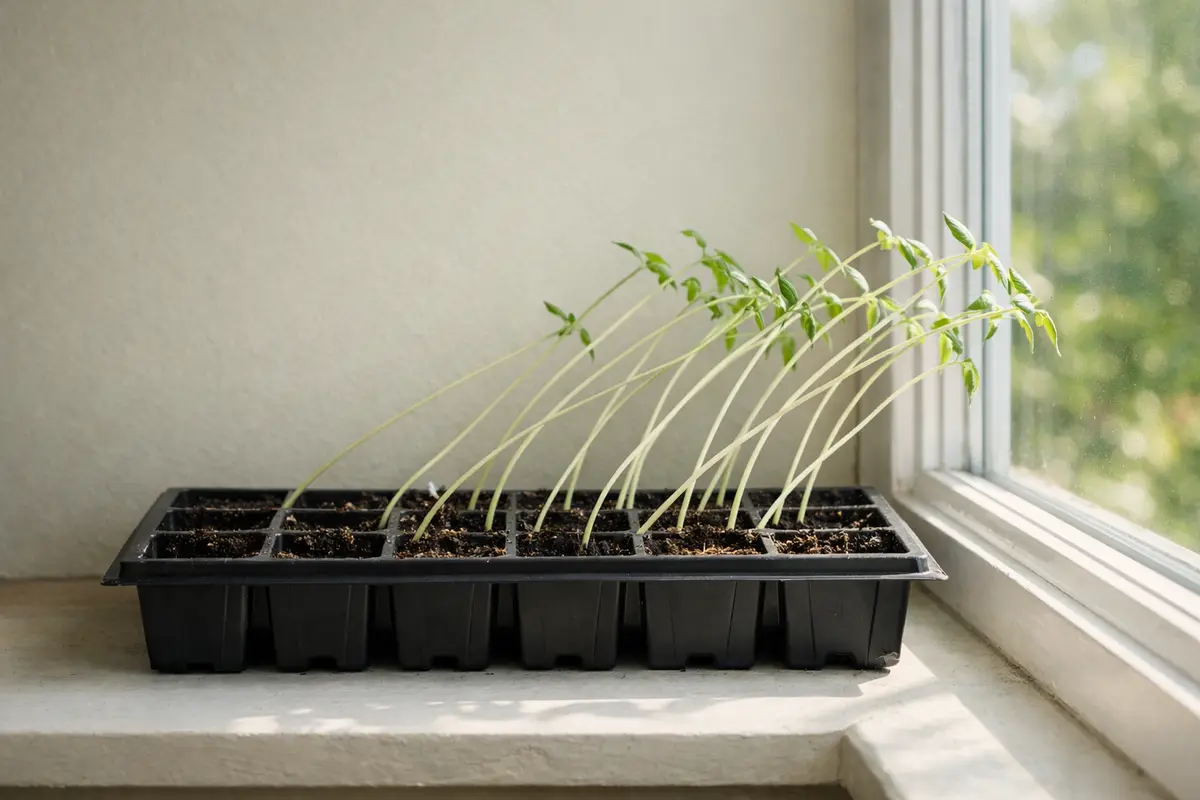
Leggy seedlings: why are they stretching?
Minnesota Extension says lack of light is the major cause of elongated, skinny stems. Answer a few questions about the light, the crowding and the warmth.
Where are the seedlings growing?
On a windowsill
Deal with it soon
A windowsill is the wrong place
Minnesota Extension says a windowsill is not a good location for starting seeds. A sill can be the coldest place in the house at night and the hottest by day, and windowsill-grown seedlings tend to be too tall, with thin, bent stems.
What to do
- Move the seedlings under an artificial light. Standard fixtures with two cool white fluorescent tubes give plants adequate light and are inexpensive.
- Hang the fixture from chains so you can raise it as the plants grow.
- If you are starting only a few plants and have roomy sills, the same source allows that a south-facing window may be all the growing space you need.
In a greenhouse or sunroom, with no lights
Deal with it soon
Daylight alone is not enough
Minnesota Extension says it is much better to grow seedlings under fluorescent or LED lights than to rely solely on natural light, even in a greenhouse.
What to do
- Add a light over the seedlings and keep it close to the plants.
- Hang it from chains so you can raise it as the plants grow.
Under fluorescent, LED or grow lights
How far are the lights above the tops of the seedlings?
Measure from the tallest tips, not from the tray.
More than 4 inches
Deal with it soon
The lights are too far above the plants
Minnesota Extension says to keep lights no more than 4 inches above the tops of the seedlings, with as close as 2 inches ideal, and says lack of light is the major cause of elongated, skinny stems.
What to do
- Lower the fixture to within 4 inches of the tops of the seedlings, or closer.
- Check the gap again as the seedlings grow and raise the fixture to keep it.
4 inches or less
How long are the lights on each day?
Fewer than 12 hours
Deal with it soon
The lights are on too few hours
Minnesota Extension says plants need 12 to 16 hours of light daily. Fewer than 12 hours is below that.
What to do
- Run the lights for 12 to 16 hours a day.
- A simple timer turns them off and on for you.
12 to 16 hours
How many seedlings share each cell or pot?
One
How warm is the room and the potting mix?
The room is below 60 degrees F, or the tray sits somewhere cold
Keep an eye on it
The seedlings are cold
Minnesota Extension asks for air temperatures above 60 degrees F and says potting mix can run as much as 5 degrees F lower than the air. It does not name cold as a cause of stretching, but cool mix can lead to seedling death from disease.
What to do
- Move the tray somewhere warmer, or put it on a heating mat made for seed starting.
- Bottom heat can also help prevent damping off.
Warm enough
Keep an eye on it
Your set-up matches the advice
The distance, the hours, the spacing and the warmth you described all fall inside Minnesota Extension's guidance, which still names lack of light as the major cause of elongated stems.
What to do
- Measure the gap again from the tops of the seedlings, which rise as they grow. As close as 2 inches is ideal.
- Keep feeding separate from the stretch. Seedlings need no fertilizer until they have several sets of true leaves.
- After that, use a weak water-soluble fertilizer at 1/4 strength, once a week, and plain water the rest of the week.
- If the problem persists, ask your county Extension office, because this page cannot name a cause outside that list.
Two or more
Keep an eye on it
Several seedlings share a cell
Minnesota Extension does not list crowding as a cause of stretching, but it is firm about cells with more than one seedling: keep the healthiest one. Seedlings in a shared container grow their roots into each other and are likely to be hurt when they are separated later.
What to do
- Once the seedlings have true leaves, cut all but the healthiest one off at ground level with scissors.
- Do not pull the extras out or try to separate them, because that can damage the roots of the one you keep.
- Next time, sow one seed per cell. Planting two or more is for older seed that germinates poorly.
All day and all night
Keep an eye on it
The lights never go off
Minnesota Extension says not to leave the lights on continuously, because many plants need some dark period each night to develop properly. It does not name this as a cause of stretching, but it is outside its advice.
What to do
- Put the lights on a timer for 12 to 16 hours a day.
- If you use a heat mat, do not plug it into the light timer.
In short: Lack of light is the major cause of long, skinny seedling stems. Get the plants off the windowsill, put the light close above them and run it for a set number of hours.
What legginess is
A leggy seedling has a long, thin stem and often a bend or a flop in it. University of Minnesota Extension is direct about the cause: lack of light is the major cause of elongated, skinny stems. The rest of its seed-starting advice reads as a list of ways to get enough light to the plants, and the questions above follow that list in order. Where a question sends you to a cause the source does not tie to stretching, the answer says so.
The fixes in order
Leave the windowsill. Minnesota Extension says a windowsill is not a good place to start seeds. The sill can be the coldest spot in the house at night and the hottest by day, and sill-grown seedlings tend to be too tall, with thin, bent stems. Its one allowance is for a few plants on roomy sills, where a south-facing window may be enough.
Use a lamp, and bring it close. The source says it is much better to grow seedlings under fluorescent or LED lights than to rely on daylight alone, even in a greenhouse. Keep the lights no more than 4 inches above the tops of the seedlings. As close as 2 inches is ideal. Hang the fixture from chains so you can raise it as the plants grow.
Keep the hours. Plants need 12 to 16 hours of light a day, and the lights should not run around the clock, because many plants need some dark each night. A simple timer does this without effort.
Keep them warm. The source asks for air above 60°F, and notes that the mix in a container can be as much as 5°F cooler than the room. It ties warmth to roots and to disease rather than to stretching.
Feed lightly, and late. Seedlings need no fertilizer until they have several sets of true leaves. After that the source suggests a weak water-soluble fertilizer at 1/4 strength, given once a week, with plain water the rest of the week.
Worked example: a shelf with a shop light
You set a shop light with two cool white tubes over a tray on a basement shelf. The seedlings are tall and floppy. On the first question you answer that they are under lights. The light turns out to be well above the tray, so the questions end at the first fix: lower the fixture to within 4 inches of the tops and keep it there as they grow. The stems are still thin a few days later, so you go through the questions again. The lights now sit close and run for the right hours, but more than one seed went into each cell. The questions send you to thin them to the healthiest one with scissors, cut at ground level, and not to pull the extras out.
If the questions above find nothing wrong, take that at face value. This page cannot name a cause outside the Minnesota list, and your county Extension office can look at the plants.
Can a leggy seedling recover
The source gives causes and fixes. It does not describe a rescue for a stem that has already stretched, and this page does not invent one. Correct the light, then watch the new growth. If seedlings fail to come up at all, that is a different problem, and the seed packet is the place to start.
Planning the next batch
Count back from your planting day by the weeks in the seed starting schedule, which lists weeks indoors by month, so the sowing date follows the plan and not the other way round. When the seedlings are big enough to leave the tray, the hardening off checklist covers potting up and the move outdoors.