
When to Plant Garlic: Fall Planting Windows by State
Updated
Figures checked against their sources on ; next check .
Or find your weather station, which also gives the frost dates some sources count from:
Or choose a state and station yourself:
Your location stays in this browser. It is only used to pick the closest stations.
| State or region | What the source says | Timed by | Source |
|---|---|---|---|
| Minnesota | “Plant cloves in the fall, usually one or two weeks after the first killing frost.” | Counted from first frost | University of Minnesota Extension |
| Utah | “Plant garlic from late September to November.” “Garlic can be planted from mid-September through early November.” | Calendar | Utah State University Extension |
| Georgia | “Late September through November is the time to plant garlic in Georgia.” | Calendar | University of Georgia Cooperative Extension |
| Pennsylvania | “Fall is the best time to plant garlic—a good three weeks prior to the ground freezing, so the roots have a chance to develop” | Counted back from ground freeze | Penn State Extension |
| Ohio | “Garlic can be planted late in the fall, after other tasks are finished.” “Ideally, the first garlic leaves should emerge above the ground prior to freezing temperatures in the fall.” | Tied to growth before freezing | Ohio State University Extension |
| Iowa | “in the fall (October to early November)” “as soon as the ground can be worked in the spring (late March to early April in central Iowa)” | Calendar | Iowa State University Extension and Outreach |
| Massachusetts | “October is the month to plant this vegetable.” “fall planting after a hard frost will give garlic plants a head start on spring growth” | Calendar | UMass Extension |
| Colorado (many locations) | “recommends planting garlic before October 15th in many Colorado locations” | Calendar | Colorado State University Extension |
| Western Colorado | “Late September into October is usually the sweet spot for garlic planting in Western Colorado.” | Calendar | Colorado State University Extension, Tri River Area |
In short: No saved source ties garlic planting to a hardiness zone, so the lookup is by state. Pick yours to see what each Extension page says, one card per source, never averaged. Only Minnesota's count from the first killing frost becomes a date, from your own weather station.
When to plant garlic in fall
Garlic is a fall crop. The cloves go into the ground in autumn, grow roots through the cold months and send up leaves in spring. The University of Georgia gives the reason: planted cloves need 6 to 8 weeks of cool weather, below 40 °F to trigger bulbing, and the size of the bulb follows how much leaf the plant grows before bulbing starts. Utah State says bulb growth is poor and yields are low from spring planting. Iowa State and UMass both allow a spring planting as a second choice, and Utah State adds that spring plantings generally make small bulbs.
So the question is how early in autumn, and the eight Extension pages behind this lookup do not give one answer. Each was written for its own state, and some tie the planting to the weather instead of the calendar. The lookup above shows each statement as its source made it, beside the state it is about, and never combines two of them.
What the sources say, state by state
Most of the pages name months. Utah State says to plant late September to November in its summary and mid-September through early November in the body of the same fact sheet, without reconciling the two. Georgia says late September through November. Iowa State says October to early November, with a spring alternative for central Iowa as soon as the ground can be worked. UMass says October, after a hard frost. Colorado State's Tri River Area office relays the university's advice to plant before October 15 in many Colorado locations and gives late September into October for the western part of the state.
Three others hang the timing on the weather instead. Minnesota says one to two weeks after the first killing frost. Penn State says 3 weeks before the ground freezes, so the roots can grow without poking through the surface. Ohio State says the first leaves should be above ground before freezing temperatures arrive, and warns that planting too early produces growth that winter can damage.
When to plant garlic by zone
None of the eight pages ties a planting date to a hardiness zone, so this page does not either. A zone describes the coldest winter nights in an area. These sources describe planting in terms of a state, a month or a freeze, and it would take a guess to turn one into the other. If you want your zone for other reasons, the hardiness zone lookup gives it from a ZIP code. For garlic, pick your state.
The lookup covers 8 states, from 8 saved pages. If your state is not among them, the result says no source is saved for it. We do not borrow a neighbor's dates, because two states in the same zone can sit far apart in climate. Ask your county Extension office, and use your station's first fall frost from the frost dates lookup as a reference point for the sources that count from frost.
How the frost count works
Only one source gives a count that can be added to a date: Minnesota's one to two weeks after the first killing frost. The page does not define a killing frost, and NOAA dates two thresholds, 32 °F and 28 °F. So the lookup counts from both and shows both, and it does not choose between them. For every other source, the station's frost date appears only as context. Penn State's ground freeze, Massachusetts's hard frost and Ohio State's freezing temperatures are not dated by NOAA's normals, so they stay as the sources worded them.
Worked example: a garden near Minneapolis
A gardener near Minneapolis picks the Minneapolis–St Paul airport station. The Minnesota card quotes the University of Minnesota: plant one to two weeks after the first killing frost. NOAA's typical first fall night at 32 °F is October 18, and at 28 °F it is October 29. Counting from the first gives October 25 to November 1. Counting from the second gives November 5 to November 12.
The two counts do not overlap, and the lookup does not average them. The gap is the source's own vagueness about what a killing frost is, not precision the page can add. Either count is consistent with the page, and the count from the harder frost lands later. She decides which reading of a killing frost she trusts, or asks her Minnesota Extension office if the choice matters. A gardener in Pennsylvania would see one card and no date, with the reason given. A gardener just across the border in Wisconsin would see that no source is saved.
After the cloves are in
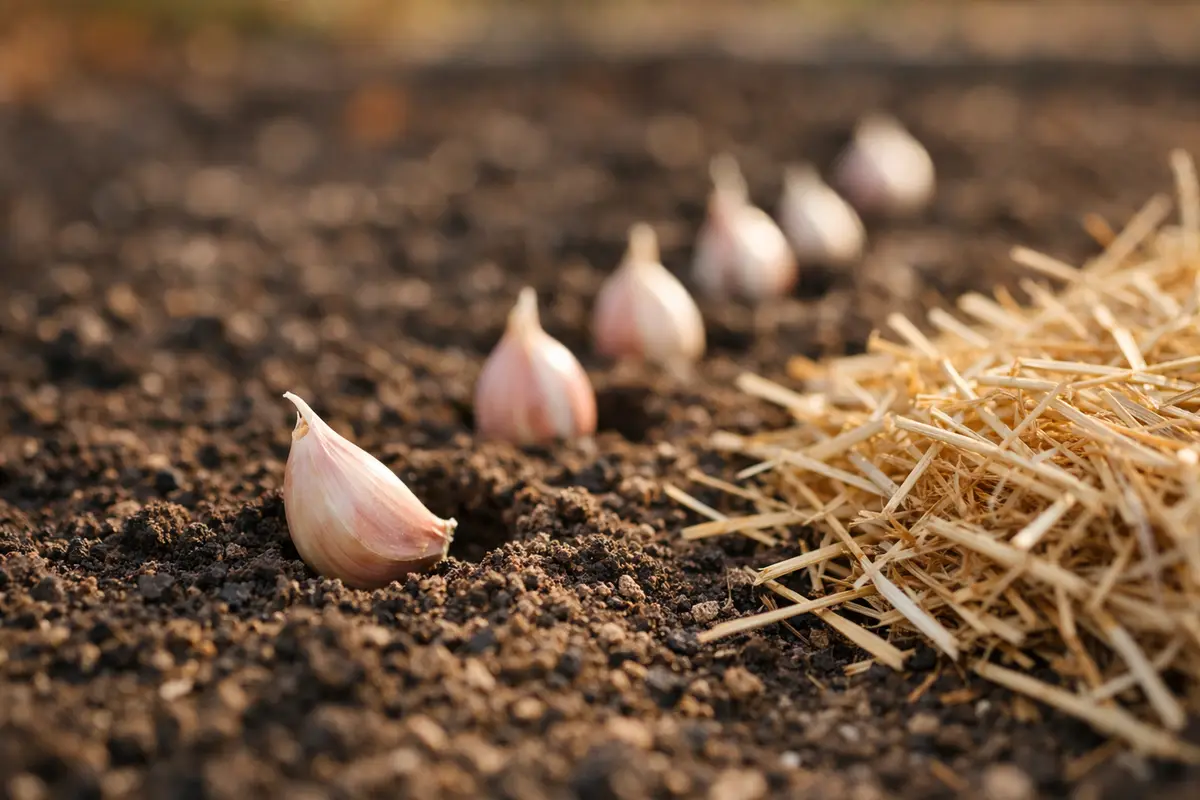
The pages that describe the planting itself agree on the main points. Plant the flat root end down and the pointed tip up, and cover the bed with straw or leaves afterward, as Minnesota, Iowa State, Penn State, Ohio State and Colorado State all do. Several of them warn against planting garlic from the grocery store, which may be a variety unsuited to your area or may have been treated against sprouting. Ohio State adds that hay is the wrong mulch because it may carry weed seed.
Related pages
How long garlic then takes to reach harvest is in the days to harvest chart, and a fall vegetable plan counted back from your first frost is in the fall planting planner.
Sources (8)
- University of Minnesota Extension (Schuh, Rosen and Tong), Growing garlic in home gardens, reviewed 2026 extension.umn.edu
- University of Georgia Cooperative Extension (Bob Westerfield), Garlic Production for the Gardener, Circular 854, published with minor revisions August 17, 2021 fieldreport.caes.uga.edu
- Penn State Extension (Paula Ream, Master Gardener), Growing Garlic - Fall Planting, updated September 9, 2026 extension.psu.edu
- Utah State University Extension (Dan Drost), How to Grow Garlic in Your Garden, published May 2020 extension.usu.edu
- Ohio State University Extension (Behnke; revised by Malinich), Growing Garlic in the Garden, HYG-1627, January 26, 2018 cfaes.osu.edu
- Iowa State University Extension and Outreach (Aaron Steil), Growing Garlic in the Home Garden, last reviewed September 2026 yardandgarden.extension.iastate.edu
- UMass Extension, Growing Garlic: Getting Started, last updated April 4, 2012 umass.edu
- Colorado State University Extension, Tri River Area (Mckenzie Moore), Fall Planting: Garlic in Western Colorado, September 23, 2025 tra.extension.colostate.edu