
Tomato Leaf Curl: Seedlings, Weather, Weed Killer, Mites or Virus
Updated
Figures checked against their sources on ; next check .
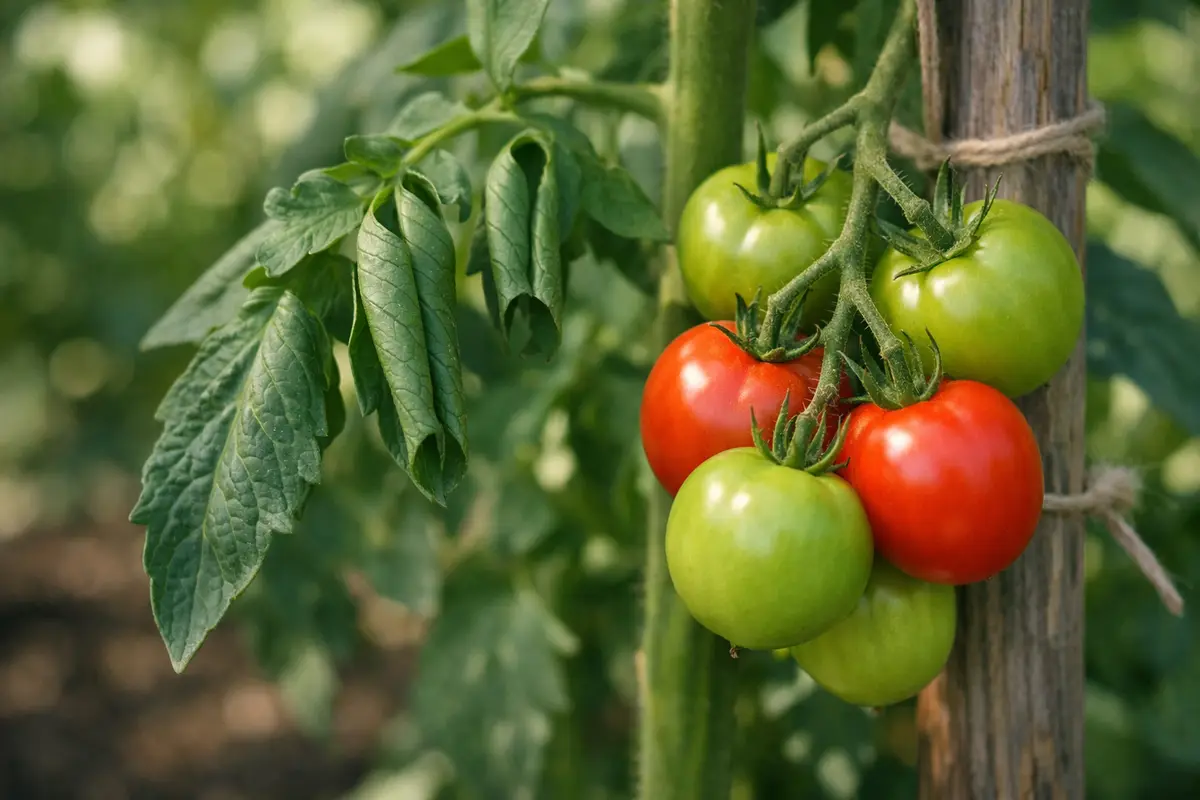
Curled tomato leaves: weather, weed killer, mites or a virus?
Start with the shape and colour of the curled leaves, or choose the seedling answer if the plants are still small and in pots. Then answer one question about the last few weeks. Look at old and new leaves and the fruit before you choose.
What do the curled leaves look like?
Georgia Extension suggests checking which leaves are rolling, which way they roll, and whether the fruit or other parts show symptoms too.
Rolled upward and inward along their length, still a normal green
When did the rolling start?
Soon after planting out, in cool weather or cold soil
Keep an eye on it
Leaf roll from planting into cold soil
UGA Extension's tomato circular says leaves can suddenly roll up, as if the plant needed water, in drought or cold weather at the very start of the season. Tomatoes planted before the soil has warmed are the most susceptible, and the circular advises waiting until the soil is above 60°F.
What to do
- Leave the plants be and keep the soil evenly moist while the weather warms.
- Watch the new growth. If it comes in flat and green, the plant is recovering.
- Next season, check the soil temperature and wait for it to pass 60°F before setting tomatoes out.
In a hot, dry or windy spell
Keep an eye on it
Physiological leaf roll from heat, drought or wind
South Dakota State Extension says the leaves roll inward lengthwise when the plant cannot supply them with enough water, cutting the area exposed to sun and wind; the lower leaves usually go first and keep their colour. Texas A&M says mild leaf roll generally does not lower yield or quality, though severe rolling can make flowers drop and fewer fruit set.
What to do
- Water during dry spells and mulch around the plants to keep soil moisture even, as Georgia Extension advises.
- Do not overcorrect: South Dakota State notes that too much water can also cause rolling.
- Expect the leaves to recover as the weather changes. Wind damage alone, Texas A&M says, normalizes once conditions improve.
After heavy rain, hard pruning, deep hoeing or a big feed of nitrogen
Keep an eye on it
Physiological leaf roll after a shock
Georgia Extension lists excess moisture and nitrogen, severe pruning, root damage and transplant shock among the causes of leaf roll; South Dakota State adds that rolling can follow severe pruning, especially on plants heavily fed with nitrogen. The rolled leaves turn thick and leathery but stay green, and Georgia says the effect on fruit production and growth is small.
What to do
- Leave the plant alone: rolled leaves need no treatment.
- Avoid deep or close hoeing near the plants, especially in dry weather.
- Feed by soil test from now on, and go easy on nitrogen.
Tips curled in to tight C shapes, rubbery or rolled downward, with twisted stems or growth
Has anything come into the garden that could carry a weed killer?
Hay, straw or manure, or compost or mulch made from them
Deal with it soon
Possible herbicide residue in manure, hay or compost
Texas A&M warns that some pasture weed killers, with the active ingredient aminopyralid, persist for 18 months on treated hay and pass into the manure of animals that eat it, so mulch or compost made from either can damage vegetables. Georgia's tomato circular also names treated manure as a cause of herbicide damage.
What to do
- Stop adding that hay, straw, manure or compost to the vegetable beds.
- Ask the supplier whether the hay, or the field it came from, was treated in the last 18 months.
- Use only well-aged manure that has been turned often, as Georgia Extension advises, and ask your county Extension office before replanting the bed.
Not that I know of, but lawns, fields or weeds nearby get sprayed
Deal with it soon
Likely herbicide drift
Tomatoes are very sensitive to growth-regulator weed killers such as 2,4-D and dicamba. South Dakota State says they can drift a mile or two and may mark tomatoes when no other plant nearby shows damage; Texas A&M says winds as low as 5 mph can carry them up to a mile. Leaves already injured cannot be fixed.
What to do
- Watch the new growth. Texas A&M says that if new shoots come in normal and at least 4 to 6 weeks of season remain, the plant may outgrow the injury.
- If new growth keeps coming in damaged, harvest any fruit worth saving, then pull the plant and replant.
- Before eating fruit from a plant you suspect, ask your county Extension office: South Dakota State says traces can reach the fruit and no level of dicamba is considered safe to eat in tomatoes.
- If you spray weeds yourself, read and follow the product label. Texas A&M advises not spraying when the wind is above 5 mph or blowing toward the garden.
Mottled yellow and green, or dull yellow with purplish veins
Deal with it soon
Could be a virus, so get it tested
Hundreds of viruses can curl tomato leaves, Texas A&M says, and the disease often goes on to show yellow-green mosaic patterns. South Dakota State describes mosaic virus as crinkled leaves with mottled colour, and curly top as leaves rolled upward that turn dull yellow with purplish veins. Symptoms vary, so a laboratory test is the way to be sure, and there is no cure.
What to do
- Photograph the whole plant, the new growth and any fruit, then send a sample or photos to your state Extension plant diagnostic lab.
- If a virus is confirmed, pull the plant and dispose of it so it cannot spread to others.
- Where tomato yellow leaf curl virus is common, Texas A&M notes varieties bred to resist it, though they can still catch other viruses.
Young leaves twisted and distorted, with bronzed or russet undersides
Deal with it soon
Possible broad mites
Texas A&M says broad mites feed on young leaves and flowers and inject toxins that badly twist and distort the leaves; a heavy infestation can bronze the undersides of leaves and the fruit. The mites cannot be seen with the naked eye, and the damage looks like other causes.
What to do
- Confirm before you treat: send affected leaves to your state Extension plant diagnostic lab.
- If the damage is severe, pull up the plants and dispose of them.
- If a treatment is recommended, read and follow the product label.
Small seedlings still in pots, indoors or just hardened off: drooping, curling or twisting
Which fits your seedlings best?
Look at the soil, the underside of the leaves and what heats the room. Seedlings answer to their pots and their air long before they answer to the weather.
Drooping and curling, perhaps with purple undersides, in cups or pots where the soil stays wet or there are no drainage holes
Deal with it soon
The pot, not the plant: drainage, acidity and feeding
University of Maine Extension answered a first-time gardener whose 3-week-old tomato seedlings were drooping and curling, with some leaf undersides turning purple. Its horticulturist saw a soil meter reading of 5.5 as toward the bottom end of what tomatoes like: they tolerate it, but 6.2 to 6.5 is better, and a low reading can hold back nutrient uptake, notably phosphorus, which can purple the leaves. He also asked about drainage holes: in cups without them, water collects at the bottom and puts seedlings at risk of damping off, a fungal root rot that can make larger plants lose foliage. West Virginia Extension adds that excess watering and poor drainage deprive the roots of air.
What to do
- Check that every cup or pot has drainage holes, and let the medium dry a little if it is soggy. Maine says root rot means the medium needs to dry quickly.
- Stop feeding for now. Maine advised holding off more fertilizer, and West Virginia says that during seedling production it is better not to use any pre-plant fertilizer.
- Pot the seedlings up into slightly larger containers with a little fresh soil-less medium around the root ball, as Maine advised. It gives the roots room and drainage and should raise the pH a little.
- Do not chase the pH with additives in small pots. Maine did not recommend adjusting it by adding anything.
Leaves curling down or twisting, with a thick stem and stunted growth, in a room with a gas or propane heater
Deal with it soon
Possible gas injury from a heater
West Virginia Extension warns that if the exhaust from a methane or propane heating system is blocked, or the gas burns incompletely, ethylene can form, and tomatoes are injured by it at concentrations as low as 0.1 parts per million. The symptoms it lists are stunted growth, pronounced downward curling or twisting of the leaves and shoots, and a thickened stem. It describes this in heated greenhouses, so treat it as a possibility for a home room only if a fuel-burning heater runs there.
What to do
- Move the seedlings to a room with no fuel-burning heater, or switch the heat source off, and make sure any heater is venting properly.
- Have the heater checked by a qualified person. This page cannot say whether yours is faulty.
- Watch the new growth. If it comes in normal after the move, gas was a likely cause.
New leaves puckered or distorted, with insects, sticky leaves or mottled colour
Deal with it soon
Distorted new growth: insects, weed killer or a virus
University of Maryland Extension lists causes that can distort vegetable seedlings as well as mature plants: aphids, which attack a long list of vegetables including tomatoes; misapplied herbicides; and virus diseases, which bring yellow mottling, mosaic patterns, ringspots and dark-green banding. It describes the upward rolling of the lower leaves on tomato plants as common in mid-summer and linked to high temperatures and moisture stress, which does not fit a small indoor seedling.
What to do
- Look under the leaves for aphids, and at the leaf colour for mottling.
- Think back over what the seedlings were potted in and whether anything was sprayed nearby. Maryland says mulching is the recommended way to keep weeds down around plants, not herbicide.
- If the colour is mottled or the growth stays twisted, send a photo or a sample to your state Extension plant diagnostic lab before you plant it out. The tree's virus outcome has the detail.
In short: Curling on small seedlings points first to the pot: drainage, acidity and feeding. On garden plants, leaves that roll upward and inward but stay green are weather or shock and do little harm; tight C-shaped curls with twisted growth point to a weed killer, mottling to a virus, bronzed young leaves to mites.
The common cause is the least worrying
Most curled tomato leaves are not a disease. Georgia, South Dakota and Texas Extension all describe physiological leaf roll: the leaflets roll upward and inward along their length, the lower leaves usually go first, and the leaves stay green, sometimes turning thick and leathery. South Dakota State explains it as the plant cutting the leaf area exposed to sun and wind when it cannot move enough water to its leaves. The triggers the three sources list are heat, drought, wind, too much water or nitrogen, severe pruning, root damage from deep hoeing, and transplant shock. Georgia adds that indeterminate varieties roll more often than determinate ones, and that no variety is fully resistant.
UGA's tomato circular describes a version early in the season: leaves suddenly roll up during drought or cold weather, mostly on plants set out before the soil has warmed. Its advice is to wait until the soil is above 60°F before planting tomatoes.
When the curl is something else
Texas A&M lists five main reasons tomato leaves twist or curl: wind, herbicide drift, herbicide residue, broad mites and viruses. The tree above asks first what the leaves look like, because that is what separates them. South Dakota State says herbicide curl is different from leaf roll: the leaf tips curl in with the sides into tight C shapes that feel rubbery and cannot be flattened. Georgia describes downward rolling with twisted growth, split stems and misshapen fruit. Viruses tend to bring colour changes, such as mottled mosaic patterns or dull yellow leaves with purplish veins. Broad mites, too small to see, twist and distort the young leaves and can bronze their undersides.
Weed killers reach gardens two ways. Drift is the familiar one: Texas A&M says winds as light as 5 mph can carry hormone-type herbicides up to a mile. Residue is the one people miss: a pasture herbicide that persists for 18 months on treated hay can pass through animals into manure, and from there into compost and mulch.
Worked example: curled top leaves after a neighbour sprays
A gardener's tomatoes have tightly curled top leaves a week after the lawn next door was sprayed for dandelions on a breezy afternoon, and the new growth is twisting. She answers the first question with the C-shaped, rubbery option, because the leaves will not flatten. She has added no hay, straw or manure this year, so on the second question she picks the sprayed lawn, and the tree ends at herbicide drift.
The leaves that are already curled will not recover, so the outcome has her watch the new growth. Texas A&M says that if new shoots come in normal and at least 4 to 6 weeks of the season remain, the plants may outgrow the injury, with new buds and leaves within about a week; if new growth keeps coming in damaged, harvest what fruit is worth saving and pull the plants. Because South Dakota State found herbicide traces can reach the fruit, she asks her county Extension office before eating any. Had the bed been mulched with hay or manure from a farm, the tree would have sent her to the residue outcome instead.
Tomato seedlings leaves curling: check the pot first
Small tomato seedlings curl for different reasons than garden plants do, and the cause is usually in the pot or the room. The tree above has a seedling answer for this. The clearest case in the saved sources is a question University of Maine Extension answered for a first-time gardener. Her seedlings were 3 weeks old and had started to droop and curl over about a week, and some leaf undersides had turned purple. The soil was moist but not wet, she had fed them a few days earlier, and a soil meter read a pH of 5.5.
The Maine horticulturist put the pH first. He called it toward the bottom end of what tomatoes like, noted that 6.2 to 6.5 is better, and said a low reading can hold back nutrient uptake, especially phosphorus, which can purple the leaves. He then asked about drainage holes, because water that collects at the bottom of a cup puts seedlings at risk of damping off. His advice was to hold off more fertilizer and to pot the seedlings up into slightly larger containers with fresh soil-less medium, which should raise the pH a little and add drainage. It was one expert's reading of one gardener's photos, so read it as a pattern to check, not as a diagnosis of yours.
Other causes of curling in seedlings
West Virginia Extension's sheet on indoor-grown seedlings names three conditions that fit. Heavy pre-plant fertilizer raises the salt content of the medium and shows first as leaf-edge scorch and stunting; it advises measuring the pH, which should sit between 6 and 7, and using no pre-plant fertilizer at all while seedlings are young. Very high humidity can make tomato leaves blister, and the sheet gives indoor relative humidity for vegetative growth as 60% to 70%. Gas from a faulty fuel-burning heater can make ethylene, which curls and twists tomato leaves downward and thickens the stem at 0.1 parts per million or more; it describes this in heated greenhouses, so it matters at home only if such a heater runs in the room.
University of Maryland Extension adds the pests and sprays that can distort seedlings and mature plants alike: aphids, misapplied weed killer and viruses. It treats the upward rolling of lower leaves as a mid-summer matter on tomato plants, tied to heat and moisture stress, which is why the seedling answer in the tree does not send a small indoor plant to leaf roll.
Example: seedlings with purple undersides
A gardener sees drooping, curling seedlings with purple leaf undersides in plastic cups. She picks the seedling answer, then the drainage and wet-soil option. The tree ends at the pot: she checks that the cups have holes, stops feeding, and pots the plants up with fresh medium around the root ball, as Maine advised. If the heater in that room burned gas, she would instead pick the second option and move the plants first.
What not to do
Do not spray rolled leaves. No source recommends a treatment for physiological leaf roll, and South Dakota State says there is no remedy for herbicide exposure. Keep the soil evenly moist instead: UGA's circular puts a tomato's needs at about 1.5 inches of water a week, and mulch helps hold it. For a confirmed pest, the product label is the only guide to use.
Related pages
Dark, sunken patches on the bottom of the fruit are a different problem, covered in the blossom end rot fix. To time planting by soil warmth, see soil temperature for planting, and to check a bed before feeding, see soil pH by plant.
Sources (7)
- University of Georgia Cooperative Extension (William G. Tyson), Georgia gardeners seeing cases of curling tomato leaves, CAES Field Report, July 11, 2012 fieldreport.caes.uga.edu
- South Dakota State University Extension (Rhoda Burrows), Why Are My Tomato Leaves Curled Up?, updated July 7, 2023 extension.sdstate.edu
- Texas A&M AgriLife Extension (Masabni, Anciso and Wallace), What Makes Tomato Leaves Twist or Curl?, EHT-064, May 2014 aggie-horticulture.tamu.edu
- University of Georgia Cooperative Extension (Bob Westerfield and Brenda Logan), Troubleshooting Cultural Problems in Tomatoes, Circular 1089, published with full review June 24, 2022 fieldreport.caes.uga.edu
- University of Maine Cooperative Extension (Jonathan Foster), Why are my tomato seedlings drooping and the leaves curling? (Ask the Expert), May 1, 2024 extension.umaine.edu
- West Virginia University Extension (Mahfuz Rahman), Common Problems Encountered in Indoor-grown Seedlings and Transplants, last reviewed April 2022 extension.wvu.edu
- University of Maryland Extension (Jon Traunfeld), Leaf Curling on Vegetables, updated July 16, 2024 extension.umd.edu