
When to Plant Peppers in Alabama: Spring and Fall Dates for Central, North and South Alabama
What Alabama’s extension calendar says about peppers, copied region by region, plus the frost record at Huntsville International Airport, Birmingham Airport, and Montgomery Airport.
Updated
Figures checked against their sources on ; next check .
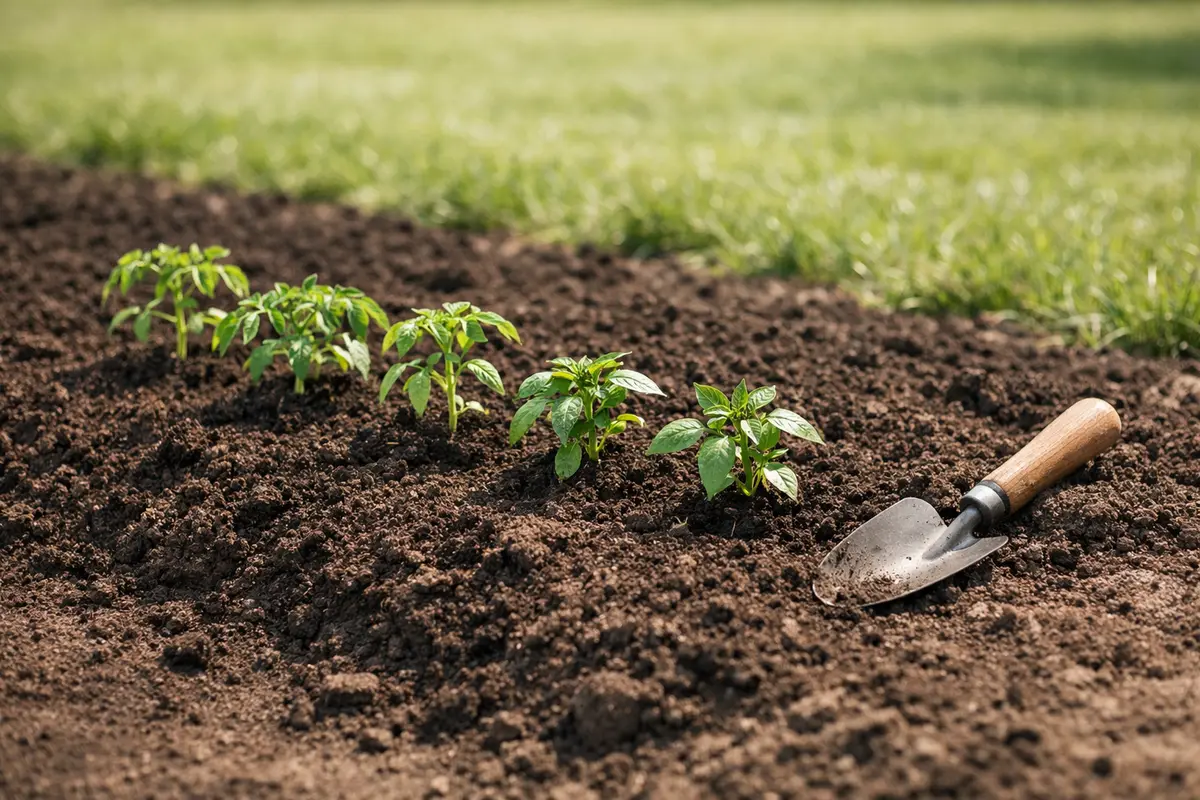
Alabama is covered by Alabama Cooperative Extension System’s own table, and peppers sit in it as a separate row for 3 parts of the state. The source gives months or relative shifts rather than calendar days; in order, Central Alabama (April 1-May 10), South Alabama (About 10 days earlier than Central Alabama), and North Alabama (About 10 days later than Central Alabama). The chart’s triple asterisk on this row marks transplants.
What Alabama Cooperative Extension System prints for peppers
Alabama’s chart gives 65 - 85 days to maturity for the row, counted from planting seed or setting transplants in the garden.
| Part of the state | Spring planting | Fall planting |
|---|---|---|
| Central Alabama | April 1-May 10 | July |
| South Alabama | About 10 days earlier than Central Alabama | About 10 days later than Central Alabama |
| North Alabama | About 10 days later than Central Alabama | About 10 days earlier than Central Alabama |
How the Alabama calendar is built
Alabama’s chart is written for Central Alabama and gives spring and fall as a month or a short range. For South Alabama the chart says to make spring plantings approximately 10 days earlier and fall plantings 10 days later; for North Alabama, spring plantings about 10 days later and fall plantings 10 days earlier.
Varieties Alabama names
On the variety question the calendar is specific, naming Cayenne, Super Chili, Habanero, Hungarian Wax, Jalapeno, Sweet Banana, Gypsy, Keystone Resistant Giant, Golden Summer, Chocolate Beauty, Purple Beauty, King Arthur, and Bell King.
These are the source’s own recommendations; this page adds none and says nothing about how each performs.
Starting peppers indoors
Indoor sowing is the one part of the job no state table above settles. The University of New Hampshire gives 8 to 10 weeks between sowing and transplanting.
Both crops appear in two of the sources, and peppers always get the longer start: UMN says 9 weeks and UGA 8, against 5 to 6 and 6 for tomatoes. NDSU and Montana State, saved here for tomatoes only, say nothing about peppers.
Once the seedlings are ready, UNH says peppers are safe to set out 2 weeks after the last frost, after hardening off.
| Source | What it says |
|---|---|
| University of New Hampshire | 8 to 10 weeks from seed to transplant; 2 weeks after the last frost is safe to set out |
| University of Minnesota | Mid-March in Minnesota, 9 weeks indoors |
| NC State | Any transplant: seed 6 to 8 weeks before setting out (central North Carolina calendar) |
| University of Georgia | 8 weeks from seed to transplant size (middle Georgia calendar) |
Frost dates for Alabama cities
Each date below is NOAA’s 50% level, meaning the last spring 32°F night lands on or after it in half the years, and the first fall night lands on or before it in half. The tool linked beside each city shows the other nine levels.
The last column maps a station to a region only where Alabama Cooperative Extension System or its county list settles it.
| Station | Last spring 32°F | First fall 32°F | Region in Alabama’s calendar |
|---|---|---|---|
| Huntsville International Airport, Alabama | March 24 | November 8 | North Alabama |
| Birmingham Airport, Alabama | March 21 | November 11 | Central Alabama |
| Montgomery Airport, Alabama | March 13 | November 13 | Central Alabama |
| Mobile Downtown Airport, Alabama | February 21 | December 6 | South Alabama |
Worked example
Pick Montgomery Airport, Alabama as the garden. Half of recent years saw their last spring 32°F night by March 13, and half saw their first fall one by November 13.
Central Alabama lists April 1 to May 10. Counting from the frost date, that is an opening 19 days after it and a close 58 days after it.
Do the same subtraction for your own town: choose its nearest station in the frost dates tool, take the 50% dates, and compare them with the row for your part of Alabama.
Before you rely on these dates
The page carries a review date of September 2018, older than most of the calendars used on this site.
Pencil the printed dates into a calendar, then adjust them after you have watched your own garden for a season.
Sources (6)
- Alabama Cooperative Extension System, Planting Guide for Home Gardening in Alabama, ANR-0063, reviewed September 2018 aces.edu
- NOAA National Centers for Environmental Information, U.S. Climate Normals 1991-2020, annual and seasonal normals (frost/freeze probabilities by station) ncei.noaa.gov
- University of New Hampshire Cooperative Extension, Growing Vegetables: When to Plant Your Vegetable Garden (fact sheet) extension.unh.edu
- University of Minnesota Extension, Starting seeds indoors (page reviewed 2026) extension.umn.edu
- NC State Extension (Bradley, Gunter, Sherk and Driscoll), Central North Carolina Planting Calendar for Annual Vegetables, Fruits, and Herbs, AG-756-01, published July 8, 2016 content.ces.ncsu.edu
- University of Georgia Cooperative Extension (Bob Westerfield), Vegetable Garden Calendar, Circular 943, published with full review March 10, 2026 extension.uga.edu