
When to Plant Peppers in Virginia: Spring and Fall Dates by Zone
One Virginia calendar, one crop: peppers, with the source’s dates left as printed and NOAA frost dates for Roanoke Regional Airport, Charlottesville Airport, and Richmond International Airport.
Updated
Figures checked against their sources on ; next check .
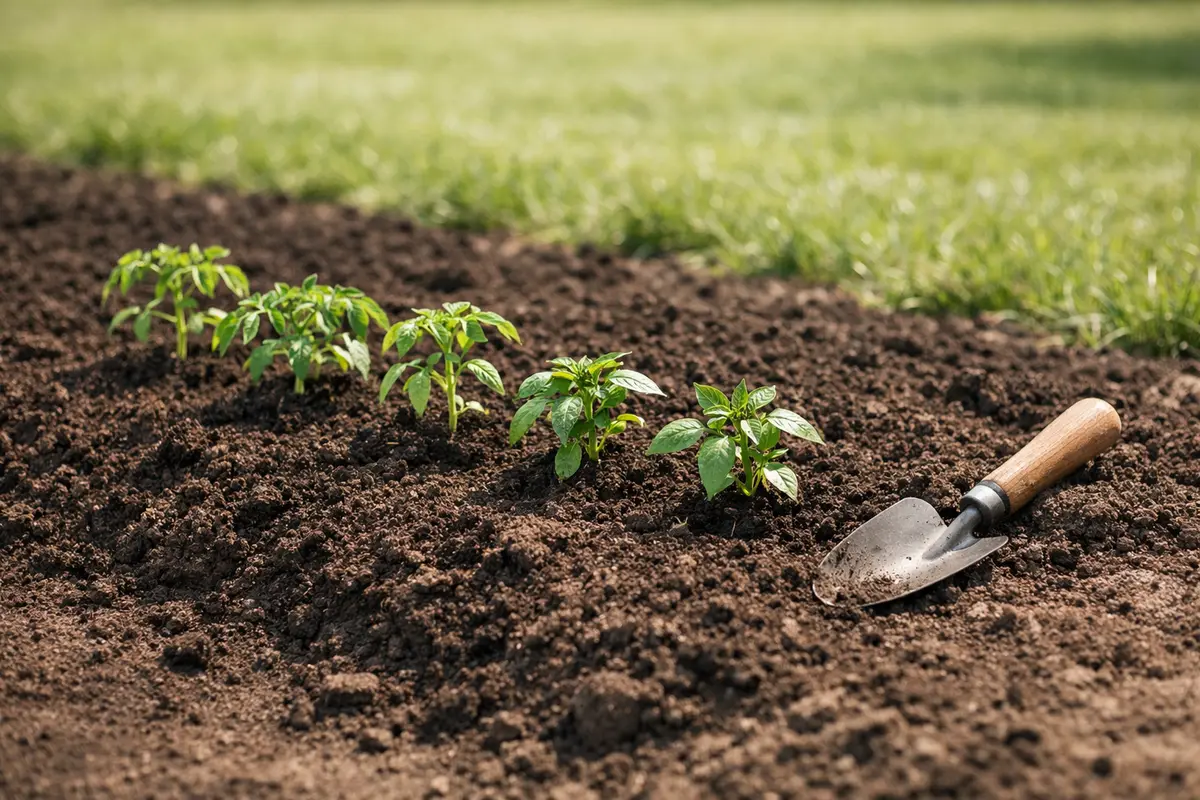
The pepper entry in Virginia’s calendar is read across 6 zones. Reading down the first date column, Zone 8b leads at April 1 and Zone 6b trails at May 10. The footnote on this row reads “Planting dates for transplants.”
Peppers: the Virginia table
Table 5 of the same guide puts peppers at 3-5 plants per person, with 2 plantings in spring and summer and none in fall.
| Zone | Spring planting | Fall planting |
|---|---|---|
| Zone 6a | May 10-July 10 | Not recommended |
| Zone 6b | May 10-July 10 | Not recommended |
| Zone 7a | April 20-July 20 | Not recommended |
| Zone 7b | April 10-Aug 1 | Not recommended |
| Zone 8a | April 10-Aug 10 | Not recommended |
| Zone 8b | April 1-Aug 10 | Not recommended |
How the Virginia calendar is built
Virginia Cooperative Extension builds its planting guide on USDA hardiness zones, from 6a to 8b, and prints a separate table of dates for each pair of zones. The guide warns that Virginia’s mountainous topography creates a diversity of hardiness zones over a small area, and it gives Roanoke County as an example: four zones, with a 30-day planting difference between them.
Where a cell reads “Not recommended”, the source gives no planting window for that season, and this page leaves it that way.
Starting peppers indoors
A calendar of outdoor dates says nothing about when the seed tray goes on the windowsill. For that, UNH offers 8 to 10 weeks of indoor growth before peppers go out.
Where a source covers both crops, peppers need more indoor time: UMN says 9 weeks and UGA 8, against 5 to 6 and 6 for tomatoes. NDSU and Montana State, saved here for tomatoes only, say nothing about peppers.
Once the seedlings are ready, UNH says peppers are safe to set out 2 weeks after the last frost, after hardening off.
| Source | What it says |
|---|---|
| University of New Hampshire | 8 to 10 weeks from seed to transplant; 2 weeks after the last frost is safe to set out |
| University of Minnesota | Mid-March in Minnesota, 9 weeks indoors |
| NC State | Any transplant: seed 6 to 8 weeks before setting out (central North Carolina calendar) |
| University of Georgia | 8 weeks from seed to transplant size (middle Georgia calendar) |
Frost dates for Virginia cities
Each date below is NOAA’s 50% level, meaning the last spring 32°F night lands on or after it in half the years, and the first fall night lands on or before it in half. The tool linked beside each city shows the other nine levels.
No city is assigned to a zone below, because the source does not assign them.
| Station | Last spring 32°F | First fall 32°F | Region in the calendar |
|---|---|---|---|
| Roanoke Regional Airport, Virginia | April 3 | November 1 | Not stated by the source |
| Charlottesville Airport, Virginia | April 3 | November 1 | Not stated by the source |
| Richmond International Airport, Virginia | April 3 | November 4 | Not stated by the source |
| Norfolk International Airport, Virginia | March 17 | November 23 | Not stated by the source |
| Washington DC Dulles Airport, Virginia | April 15 | October 24 | Not stated by the source |
Worked example
Pick Charlottesville Airport, Virginia as the garden. Half of recent years saw their last spring 32°F night by April 3, and half saw their first fall one by November 1.
The calendar does not say which zone Charlottesville Airport belongs to, so set the date against the rows at each end. Zone 8b opens April 1, 2 days before that date; Zone 6b opens May 10, 37 days after it.
This is arithmetic on two printed figures, not a forecast: it moves with the year, and your own garden can sit weeks away from the station. Look up the station nearest you in the frost dates tool and repeat the subtraction.
Before you rely on these dates
The guide says actual last and first killing frost dates vary with local conditions and from year to year, and invites gardeners to favor earlier or later dates within a range.
Weather in the week of planting matters more than the printed date; use it to nudge the start earlier or later.
Sources (6)
- Virginia Cooperative Extension, Virginia Tech (Jadrnicek and Hessler), Virginia's Home Garden Vegetable Planting Guide: Recommended Planting Dates and Amounts to Plant, publication 426-331 (SPES-673P), May 30, 2025 pubs.ext.vt.edu
- NOAA National Centers for Environmental Information, U.S. Climate Normals 1991-2020, annual and seasonal normals (frost/freeze probabilities by station) ncei.noaa.gov
- University of New Hampshire Cooperative Extension, Growing Vegetables: When to Plant Your Vegetable Garden (fact sheet) extension.unh.edu
- University of Minnesota Extension, Starting seeds indoors (page reviewed 2026) extension.umn.edu
- NC State Extension (Bradley, Gunter, Sherk and Driscoll), Central North Carolina Planting Calendar for Annual Vegetables, Fruits, and Herbs, AG-756-01, published July 8, 2016 content.ces.ncsu.edu
- University of Georgia Cooperative Extension (Bob Westerfield), Vegetable Garden Calendar, Circular 943, published with full review March 10, 2026 extension.uga.edu