
When to Plant Tomatoes in Georgia: Spring and Late-Season Dates
What Georgia’s extension calendar says about tomatoes, copied region by region, plus the frost record at Atlanta Hartsfield International Airport, Macon Middle Ga Regional Airport, and Augusta Bush Field Airport.
Updated
Figures checked against their sources on ; next check .
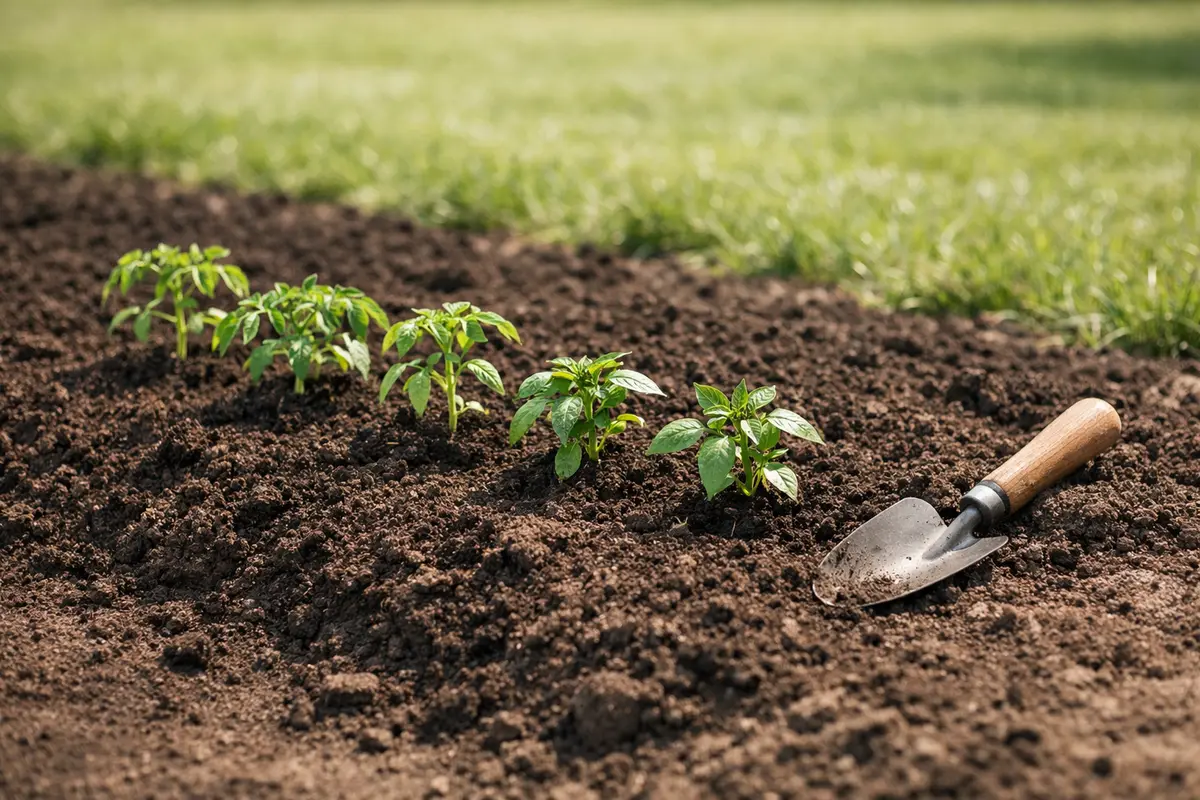
University of Georgia Cooperative Extension gives tomatoes their own row, with dates for 3 parts of the state. This calendar is coarser than most: Middle Georgia (April, with the other frost-tender crops), South Georgia (Spring planting dates as much as 2 to 3 weeks earlier), and North Georgia (Spring planting dates 1 to 3 weeks later, moving north through the mountain counties).
Tomatoes: the Georgia table
UGA’s February entry has gardeners sow seed boxes, saying tomatoes take 6 weeks from seed to transplant size.
In May the circular says to try a few tomato plants on stakes or trellises and to start removing suckers. In September and October it says to harvest mature green peppers and tomatoes before frost gets them.
| Part of the state | Spring planting | Late-season planting |
|---|---|---|
| Middle Georgia | April, with the other frost-tender crops | By July 20 to mature before frost |
| South Georgia | Spring planting dates as much as 2 to 3 weeks earlier | Fall planting dates as much as 2 weeks later |
| North Georgia | Spring planting dates 1 to 3 weeks later, moving north through the mountain counties | Fall planting dates about 2 weeks earlier |
Reading the University of Georgia Cooperative Extension table
The University of Georgia’s vegetable garden calendar is a month-by-month list for middle Georgia, a belt across the state from Columbus through Macon to Augusta. The circular bases its recommendations on long-term average dates of the last killing frost in spring and the first killing frost in fall.
Starting tomatoes indoors
None of the figures in this section belong to Georgia. They are general: UNH, for one, puts the time from seed to transplant at 6 to 8 weeks.
For tomatoes the saved record holds six sources. Three of them (UNH, NDSU and Montana State) count from the last frost; the University of Minnesota, NC State and the University of Georgia describe their own climates. The shortest figure is 5 weeks and the longest 10, so no single number is right for every garden.
Once the seedlings are ready, UNH says tomatoes are safe to set out 1 to 2 weeks after the last frost, after hardening off.
| Source | What it says |
|---|---|
| University of New Hampshire | 6 to 8 weeks from seed to transplant; 1 to 2 weeks after the last frost is safe to set out |
| North Dakota State University | Sow 6 weeks before the last frost, transplant 2 weeks after it |
| Montana State University | 6 to 10 weeks to transplant size; the planting window opens 1 week before the last frost |
| University of Minnesota | Early April in Minnesota, 5 to 6 weeks indoors |
| NC State | Any transplant: seed 6 to 8 weeks before setting out (central North Carolina calendar) |
| University of Georgia | 6 weeks from seed to transplant size (middle Georgia calendar) |
Typical frost dates at Georgia stations
Each date below is NOAA’s 50% level, meaning the last spring 32°F night lands on or after it in half the years, and the first fall night lands on or before it in half. The tool linked beside each city shows the other nine levels.
A station is tied to a region of the calendar only where the source’s own wording makes that call; the rest are left blank on purpose.
| Station | Last spring 32°F | First fall 32°F | Region in Georgia’s calendar |
|---|---|---|---|
| Atlanta Hartsfield International Airport, Georgia | March 15 | November 20 | Not stated by the source |
| Macon Middle Ga Regional Airport, Georgia | March 21 | November 10 | Middle Georgia |
| Augusta Bush Field Airport, Georgia | March 23 | November 9 | Middle Georgia |
| Columbus Metro Airport, Georgia | March 5 | November 23 | Middle Georgia |
| Savannah International Airport, Georgia | March 2 | November 30 | Not stated by the source |
Worked example
NOAA’s normals for Macon Middle Ga Regional Airport, Georgia give March 21 as the even-odds date of the last spring 32°F night, and November 10 as the even-odds first fall one.
Middle Georgia is entered by month only (April), and the median last freeze, March 21, falls before the window opens.
On the fall side, Middle Georgia’s last planting date of July 20 leaves 113 days before the November 10 median first freeze.
None of this predicts next spring. It only lines up two published sets of dates; swap in your own station from the frost dates tool and the same steps apply.
Before you rely on these dates
The circular gives the last planting dates for fall crops, not a window, so the second column is a deadline.
Weather in the week of planting matters more than the printed date; use it to nudge the start earlier or later.
Sources (7)
- University of Georgia Cooperative Extension (Bob Westerfield), Vegetable Garden Calendar, Circular 943, published with full review March 10, 2026 extension.uga.edu
- NOAA National Centers for Environmental Information, U.S. Climate Normals 1991-2020, annual and seasonal normals (frost/freeze probabilities by station) ncei.noaa.gov
- University of New Hampshire Cooperative Extension, Growing Vegetables: When to Plant Your Vegetable Garden (fact sheet) extension.unh.edu
- NDSU Extension Service (North Dakota State University), Time and Temperature Chart, from How to Succeed at Seed Starting, publication h1139, print code 2M-2-99 library.nd.gov
- Montana State University Extension (Amy Grandpre), Can I Grow That Here? Vegetable Seed and Transplant Schedules for Garden or Container, MontGuide MT199308AG, revised November 2018 extension-store.montana.edu
- University of Minnesota Extension, Starting seeds indoors (page reviewed 2026) extension.umn.edu
- NC State Extension (Bradley, Gunter, Sherk and Driscoll), Central North Carolina Planting Calendar for Annual Vegetables, Fruits, and Herbs, AG-756-01, published July 8, 2016 content.ces.ncsu.edu