
When to Plant Tomatoes in Kentucky: Earliest and Latest Dates by Region
What Kentucky’s extension calendar says about tomatoes, copied region by region, plus the frost record at Louisville International Airport, Lexington Bluegrass Airport, and Bowling Green Warren County Airport.
Updated
Figures checked against their sources on ; next check .
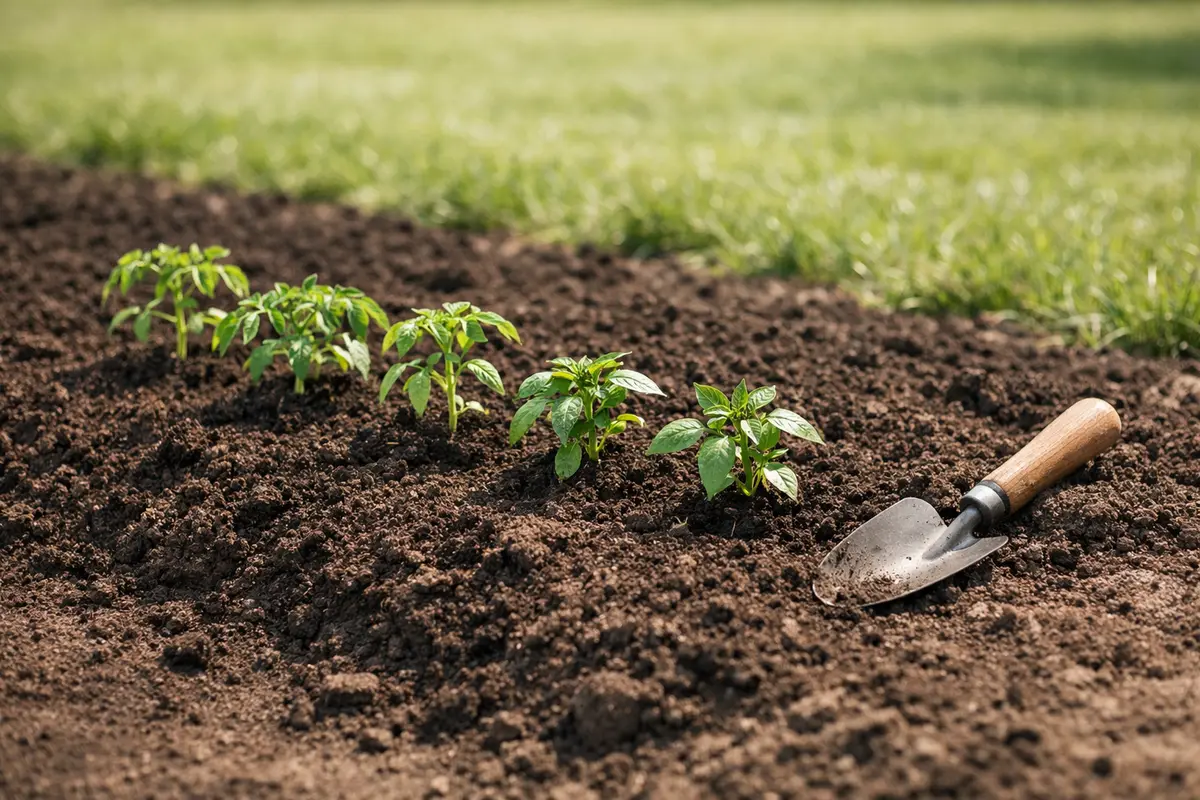
The tomato entry under the heading “Tomatoes (plants)” in Kentucky’s calendar is read across 3 regions. Across the rows, the first date to appear is April 20 (Western Kentucky) and the last is May 15 (Eastern Kentucky), 25 days apart. The row is labelled “(plants)”, so its dates are for transplants.
Tomatoes: the Kentucky table
Kentucky’s own transplant table, Table 20.6, lists tomato at 4-7 weeks from seeding to transplanting and an average seedling date of Mar. 15.
| Region | Earliest safe planting date | Latest safe planting date |
|---|---|---|
| Western Kentucky | Apr 20 | July 1 |
| Central Kentucky | May 5 | June 15 |
| Eastern Kentucky | May 15 | June 1 |
Reading the University of Kentucky Cooperative Extension table
The University of Kentucky’s home vegetable gardening chapter gives each crop an earliest and a latest safe planting date for Western, Central and Eastern Kentucky. The two halves of its table run in opposite directions: the earliest-date columns read Western, Central, Eastern, while the latest-date columns read Eastern, Central, Western.
Starting tomatoes indoors
None of the figures in this section belong to Kentucky. They are general: UNH, for one, puts the time from seed to transplant at 6 to 8 weeks.
For tomatoes the saved record holds six sources. Three of them (UNH, NDSU and Montana State) count from the last frost; the University of Minnesota, NC State and the University of Georgia describe their own climates. The shortest figure is 5 weeks and the longest 10, so no single number is right for every garden.
Once the seedlings are ready, UNH says tomatoes are safe to set out 1 to 2 weeks after the last frost, after hardening off.
| Source | What it says |
|---|---|
| University of New Hampshire | 6 to 8 weeks from seed to transplant; 1 to 2 weeks after the last frost is safe to set out |
| North Dakota State University | Sow 6 weeks before the last frost, transplant 2 weeks after it |
| Montana State University | 6 to 10 weeks to transplant size; the planting window opens 1 week before the last frost |
| University of Minnesota | Early April in Minnesota, 5 to 6 weeks indoors |
| NC State | Any transplant: seed 6 to 8 weeks before setting out (central North Carolina calendar) |
| University of Georgia | 6 weeks from seed to transplant size (middle Georgia calendar) |
Typical frost dates at Kentucky stations
Each date below is NOAA’s 50% level, meaning the last spring 32°F night lands on or after it in half the years, and the first fall night lands on or before it in half. The tool linked beside each city shows the other nine levels.
The source leaves it to the reader to place a city among its regions, and this table does not make that call.
| Station | Last spring 32°F | First fall 32°F | Region in the calendar |
|---|---|---|---|
| Louisville International Airport, Kentucky | March 31 | November 7 | Not stated by the source |
| Lexington Bluegrass Airport, Kentucky | April 13 | October 28 | Not stated by the source |
| Bowling Green Warren County Airport, Kentucky | April 5 | October 31 | Not stated by the source |
| London Corbin Airport, Kentucky | April 15 | October 25 | Not stated by the source |
Worked example
Pick Louisville International Airport, Kentucky as the garden. Half of recent years saw their last spring 32°F night by March 31, and half saw their first fall one by November 7.
The calendar does not say which region Louisville International Airport belongs to, so set the date against the rows at each end. Western Kentucky opens April 20, 20 days after that date; Eastern Kentucky opens May 15, 45 days after it.
On the fall side, Eastern Kentucky’s last planting date of June 1 leaves 159 days before the November 7 median first freeze.
This is arithmetic on two printed figures, not a forecast: it moves with the year, and your own garden can sit weeks away from the station. Look up the station nearest you in the frost dates tool and repeat the subtraction.
Before you rely on these dates
The chapter says its planting dates are approximate and should be adjusted to local weather.
Pencil the printed dates into a calendar, then adjust them after you have watched your own garden for a season.
Sources (8)
- University of Kentucky Cooperative Extension Service (editor Richard Durham), Home Vegetable Gardening in Kentucky, ID-128, revised January 2024 publications.mgcafe.uky.edu
- NOAA National Centers for Environmental Information, U.S. Climate Normals 1991-2020, annual and seasonal normals (frost/freeze probabilities by station) ncei.noaa.gov
- University of New Hampshire Cooperative Extension, Growing Vegetables: When to Plant Your Vegetable Garden (fact sheet) extension.unh.edu
- NDSU Extension Service (North Dakota State University), Time and Temperature Chart, from How to Succeed at Seed Starting, publication h1139, print code 2M-2-99 library.nd.gov
- Montana State University Extension (Amy Grandpre), Can I Grow That Here? Vegetable Seed and Transplant Schedules for Garden or Container, MontGuide MT199308AG, revised November 2018 extension-store.montana.edu
- University of Minnesota Extension, Starting seeds indoors (page reviewed 2026) extension.umn.edu
- NC State Extension (Bradley, Gunter, Sherk and Driscoll), Central North Carolina Planting Calendar for Annual Vegetables, Fruits, and Herbs, AG-756-01, published July 8, 2016 content.ces.ncsu.edu
- University of Georgia Cooperative Extension (Bob Westerfield), Vegetable Garden Calendar, Circular 943, published with full review March 10, 2026 extension.uga.edu